
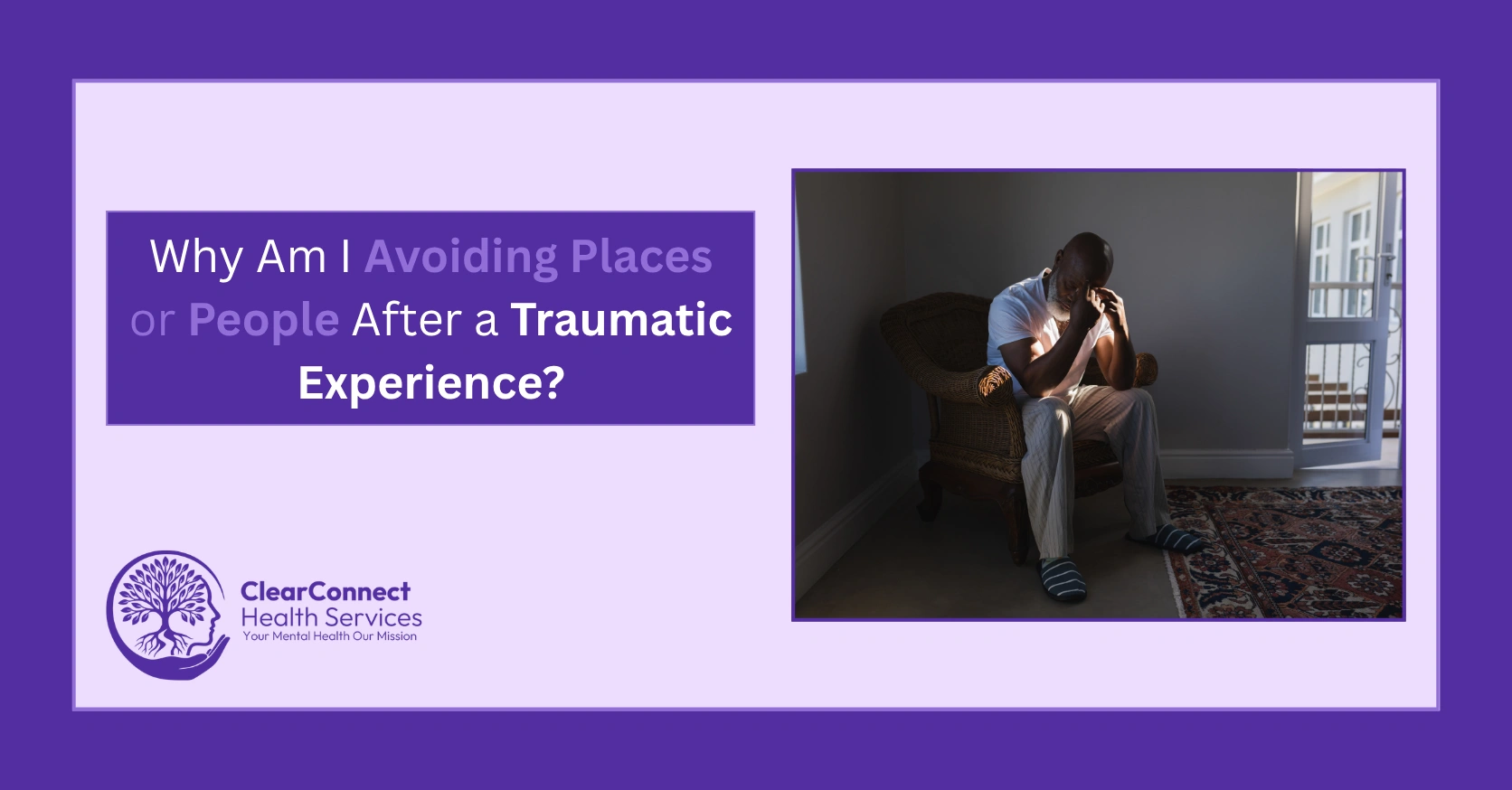
Have you ever entered a grocery store and felt your heart race upon seeing someone familiar, wanting to leave?
If you’ve gone through something traumatic, you might find yourself avoiding places or people connected to that event like a park or certain routes.
You may wonder:
“Why am I avoiding places or people after a traumatic event? Why can’t I just go back to normal?”
It’s normal to feel confused or ashamed after trauma, wondering why moving on is hard.
At Clear Connect Health Services, we provide evidence-based mental health care for those dealing with trauma, focusing on evaluation, personalized treatment and supportive care to help you understand and heal.
What Is a Traumatic Experience?
A traumatic experience is something very scary, painful, or upsetting.
Examples include:
- A car accident
- A serious injury
- A natural disaster
- Losing someone you love
- Being hurt by another person
- A sudden health emergency
When trauma occurs, your brain retains details of the event. It recalls a story of where, who, and how.
Your brain does this because it doesn’t want to be at risk from future dangers.
Why Am I Avoiding Places or People After a Traumatic Experience?
You may avoid certain places or people because your brain is trying to keep you safe.
After trauma, your brain can stay on high alert. It may act like danger is still nearby, even when you are safe.
When something triggers a memory of the trauma, your brain may issue a warning:
“Keep away. This could hurt you again.”
Avoidance after trauma is a typical response. It doesn’t signify weakness or brokenness.
It simply indicates that your brain is working to shield you.
However, avoiding things can make fear stronger over time. When you always avoid something, your brain may learn:
“That place or person must be dangerous.”
Slowly, you may start avoiding more things and your world may feel smaller.
What Happens in Your Brain After Trauma?
Experiencing trauma can increase your brain’s sensitivity to danger. It looks like a smoke detector that continues to sound an alarm long after the danger has passed.
Your brain may trigger responses to stimuli related to the traumatic event as if you were in danger again. You might experience:
- A racing heartbeat
- Sweating
- Trouble breathing
- Muscle tension
- Feeling frozen or overwhelmed
- A strong urge to escape
This is the body’s response of fight or flight. It’s meant to keep you safe when danger threatens, but sometimes it can go into overdrive when you’re safe, even after trauma.
Due to the fear these sensations can provoke, you might start avoiding anything that brings them on.
How Avoidance Becomes a Cycle
Avoidance often happens in a pattern:
- Something scary or painful happens.
- You feel fear, sadness, or stress.
- You avoid reminders of what happened.
- You feel better for a short time.
- Your brain learns: “Avoiding this kept me safe.”
- The fear becomes stronger later.
Avoidance can help you feel better for a little while, but it can make healing harder.
Healing means slowly teaching your brain:
“I can face this reminder, and I am still safe.”
What Might You Be Avoiding?
After trauma, people may avoid many different reminders, including:
Places
A store, street, workplace, neighborhood, or location connected to the event
People
Someone involved in the experience or someone who reminds you of it
Activities
You may stop doing things you once enjoyed because they now feel connected to fear.
Conversations
You may avoid discussing the event or anything related to it.
Sometimes avoidance spreads beyond the original situation. For example:
- If something happened at night, you may avoid going out after dark
- If something happened in a crowded area, you may avoid public spaces
- If someone hurt you, you may struggle with trusting others
These reactions are your brain’s attempt to protect you, but they can also prevent you from fully engaging in life.
If several of these symptoms sound familiar, trauma may still be affecting your daily life. Support can help.
How Professional Mental Health Care Can Help
Healing from trauma is achievable through structured, evidence-driven support.
At Clear Connect Health Services, we provide complete outpatient mental health care. Our goal is to help people understand their symptoms and receive personalized treatment.
Our method highlights:
- In-depth psychiatric assessments
- Precise diagnoses
- Considerate treatment strategies
- Continuous follow-up support
- Evidence-based medication management as needed
We carefully assess trauma-related symptoms while also recognizing co-occurring conditions, such as anxiety disorders, depression and adult ADHD.
Knowing the full context lets us make personalized treatment plans. These plans help create lasting progress.
Our Structured Evaluation Process
Every person’s experience with trauma is different.
That is why we use a structured assessment process rather than making quick assumptions.
Our evaluation may include:
- Clinical interviews
- Detailed symptom review
- Functional impact assessment
- Medical and mental health history
- Review of co-existing conditions
- Development of a personalized treatment plan
This careful approach helps ensure diagnostic clarity and appropriate care through a comprehensive evaluation process.
Clear Connect Health Services provides secure telehealth appointments across Virginia, allowing adults to receive psychiatric care from home.
Steps You Can Take to Begin Healing
Healing takes time. Small steps can help.
Notice Avoidance Without Blaming Yourself
Try saying:
“I’m avoiding this because it brings up painful memories.”
Understanding your feelings is the first step.
Be Kind to Yourself
Try saying:
“This is hard, and it makes sense that I am struggling.”
Treat yourself with patience.
Take Small Steps
You do not need to face your biggest fear right away.
You can start by:
- Looking at a picture of the place
- Talking about the memory for a short time
- Visiting with someone you trust
- Spending a few minutes in the place
Small steps can lead to progress.
Try Grounding Techniques
When you feel anxious, focus on the present moment.
You can:
- Feel your feet on the floor
- Name things you see, hear and feel
- Take slow breaths
- Hold a comforting object
Talk with Supportive People
You don’t have to recover by yourself. Supportive friends, family and mental health experts can assist you.
Conclusion
Trauma can change how you see the world, but it does not have to control your future.
Avoiding places or people after trauma is your brain’s way of trying to protect you.
It does not mean you failed.
With support, patience and small steps, you can begin to feel safe again. You can reconnect with the people, places and activities that are important to you.
Ready to Get Help?
If you are struggling with trauma symptoms, anxiety, focus problems, adult ADHD, or mood concerns, Clear Connect Health Services provides structured, evidence-based mental health care through secure telehealth appointments across Virginia.
Call or Text: (540) 779-8166
Schedule Your Appointment Today
FAQs
Is avoiding places after trauma a sign of weakness?
No. Avoiding places or people after trauma is common. It means your brain is trying to protect you after a difficult experience.
What if therapy feels scary?
It’s normal to feel nervous. A supportive therapist will help you go at your own pace.
No comment